
Madison County Criminal Court Cases
Madison County is part of Georgia's Northern Judicial Circuit. Superior Court tries felonies and its clerk keeps indictments or accusations, motions, pleas, judgments, sentences, and restriction or sealing filings. Magistrate Court handles warrants, first appearances, bond, extradition, committal, ordinances, bad-check cases, and only specified misdemeanors. Probate Court receives traffic questions routed by Magistrate, while municipal courts retain their own authorized city matters.
A search in one court does not clear all Madison County court records. Identify the issuing agency, case number, and charge type first. Clerk Katie Cross is the Superior Court custodian at 91 Albany Avenue, Danielsville, phone 706-795-6310.
Felonies in the Northern Circuit
The Northern Judicial Circuit District Attorney serves Madison, Elbert, Franklin, Hart, and Oglethorpe counties. Prosecutors decide which supported charges move forward and whether a felony proceeds by indictment or accusation where Georgia law permits. An officer's booking label is not the final filed count.
The circuit structure also explains why some services sit outside Danielsville. The circuit public defender operates from Royston, but defense counsel is not the public-record custodian.
The official Northern Circuit source is pictured below and places Madison prosecutions in their proper circuit.
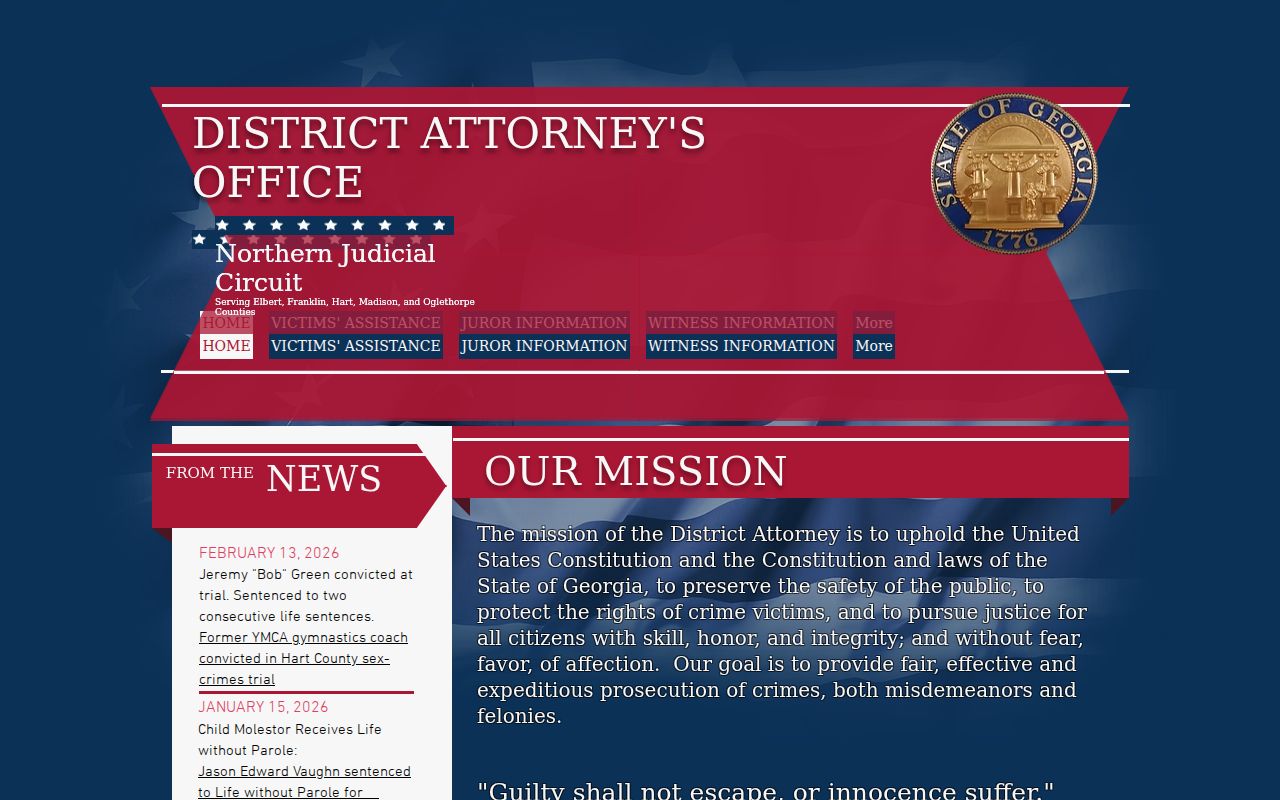
This circuit view helps separate the prosecutor's role from the clerk's recordkeeping role.
Searching Madison County Case Records
The clerk links Web Case Management, but inspection in July 2026 met a redirect loop or access denial. Treat the link as a first try, not guaranteed access. The dependable fallback is the clerk by phone or at the Albany Avenue counter. Ask if an older file needs archive retrieval and whether a certified disposition is available.
- Start with the full case number; otherwise give the full name and a narrow date range.
- Confirm whether Superior, Magistrate, Probate, or a municipal court owns the file.
- Read every count, its statute, status, and outcome separately.
- Compare hearing entries with the clerk's calendar, which proves scheduling only.
- Request the signed judgment or certified disposition when the outcome must be proved.
| Field Label | Type | Required | Notes |
|---|---|---|---|
| Party name | Text | Fallback | Confirm the person with lawful details. |
| Case number | Text | Best field | Use the complete court number. |
| Filing year | Date range | Helpful | Narrows common-name results. |
| Court and status | Result | Verify | Fields were not interactively confirmed. |
Madison Criminal Calendars
The clerk posts judge- and date-specific PDFs labeled Wasserman Criminal Motion Calendar, Phelps Criminal Motion, Phelps Order for Criminal Trial, and Nesmith Criminal Motion. A calendar can confirm a scheduled event when the portal fails, but it is not a full docket or disposition.
Use the judge, date, and case number to request the order. Never treat calendar names as a list of convicted people because hearings move and charges can be dismissed.
Note: Scheduling evidence does not establish that the hearing occurred or how the court ruled.
Inside a Madison County Case File
A docket header identifies the case, court, filing date, type, and status. Party fields separate the State, defendant, and counsel. Count detail is crucial because one case can combine charges with different outcomes. The event log may include accusation or indictment, arraignment, motions, notices, plea, trial, judgment, sentence, probation, or revocation. Index visibility does not promise free document images.
| Case and parties | Number, court, dates, State, defendant, counsel, and status. |
|---|---|
| Charging document | Indictment or accusation with each filed offense and statute. |
| Docket entries | Motions, hearings, notices, pleas, orders, and trial events. |
| Disposition | Dismissal, nolle prosequi, acquittal, or conviction by count. |
| Sentence | Custody, probation, fines, costs, restitution, and conditions. |
Madison Magistrate Is Not Trial
First appearance and bond in Magistrate Court are early steps, not a felony trial. The office is at Suite 401, 91 Albany Avenue, Danielsville, 706-795-6375, weekdays 8 a.m. to 5 p.m. Misdemeanor citations are scheduled on the second Tuesday monthly at 9 a.m.; county ordinances are set on the third Tuesday.
Madison County Magistrate Court
91 Albany Avenue, Suite 401
Danielsville, GA 30633
706-795-6375
Weekdays, 8 a.m.-5 p.m.
The official Magistrate Court page is pictured below.
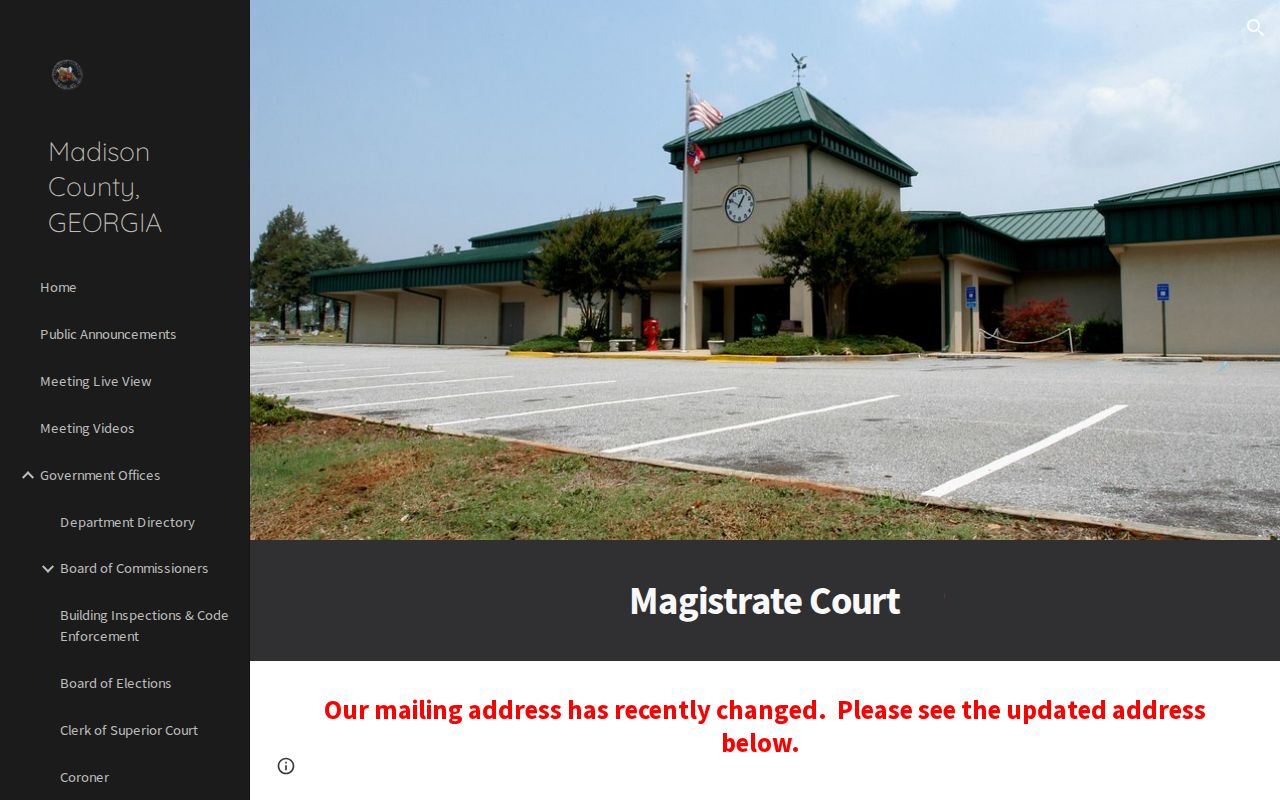
Its limited jurisdiction shows why the correct court must be identified before requesting a docket.
How a Criminal Case Moves
Each stage creates a different record. Booking captures initial custody facts. A prosecutor may revise or decline charges. The clerk then records the filed instrument and later events. A plea or verdict resolves each count, and sentencing records punishment and supervision.
Charges Filed → Arraignment → Pretrial → Plea or Trial → Disposition → Sentencing
- Accusation
- A prosecutor-filed charging paper used where allowed.
- Indictment
- A felony charge returned by a grand jury.
- Nolle prosequi
- A formal choice not to continue the charge then.
- Disposition
- The outcome of each count.
Certified Madison County Dispositions
A certified disposition is the best court product when an outcome is missing or wrong in a Georgia Crime Information Center history. Retrieve the docket, identify all counts, and ask the clerk for the signed outcome with certification. Then identify the arresting agency and prosecutor because the source agency owns its arrest or disposition entry.
GCIC normally needs certified source material or authorization to amend a cycle. Restriction limits ordinary dissemination of eligible history; sealing can limit court access. Neither means physical destruction.
Key distinction: O.C.G.A. §35-3-37 provides separate restriction and court-sealing pathways.
Case Record Access & Restrictions
The Georgia Open Records Act favors public access, but judicial files have their own custodian. Victim and minor identifiers, Social Security and account numbers, sealed filings, and grand-jury deliberations are not ordinary public fields. Ask for segregable portions when only part is exempt.
Online absence proves little. An old file may not be indexed, the portal can fail, or a sealed matter may be hidden. A visible case also does not prove conviction. Read each count and obtain the order. The Madison County arrest lookup explains the separate booking trail.
The Georgia Public Defender Council resource below concerns defense services, not certified records.

Keeping service and record channels distinct sends the request to the office that can certify the file.
When Web Case Management Does Not Open
Madison County's clerk homepage links to Web Case Management, yet the interface produced a redirect loop and access denial during the July 2026 research check. That failure does not mean the case is unavailable. Call the Superior Court clerk at 706-795-6310, give the case number when possible, and ask whether the file is active, archived, sealed, or held by a different court. The in-person counter is at 91 Albany Avenue in the Madison County Government Complex, not the historic 1901 courthouse. Mail can be directed to P.O. Box 247, Danielsville, GA 30633. Confirm current counter hours and copying instructions before traveling or sending payment.
Magistrate matters have a separate route. Contact Suite 401 at 706-795-6375 or MCmagistrate@madisonco.us for a warrant application, first-appearance record, bond matter, county ordinance case, or misdemeanor citation assigned to that court. Probate Court answers traffic-citation questions at 706-795-6365. A city citation may remain with the issuing municipal court, so use the Comer, Danielsville, or Colbert record route rather than assuming every local charge appears in Superior Court.
Portal fallback: record the error, keep the full name and date range ready, call the clerk, and ask about archive retrieval. Do not interpret a blank or blocked web result as proof that no case exists.
Fees, Filing, and Case Assistance
The research did not locate a complete Madison County Superior Court copy-and-certification fee schedule, so request a quote from the clerk instead of borrowing a price from another Georgia county. Magistrate Court publishes a $30 warrant-application fee and a $30 deposit-account-fraud warrant fee on its July 1, 2026 schedule. It accepts Visa and Mastercard, while online filings carry additional, nonrefundable charges. A filing submitted after 4:30 p.m. receives the next business day's stamp. Those Magistrate figures do not establish what Superior Court charges for copies or certification.
The office needed for help depends on the question. The Northern Judicial Circuit District Attorney prosecutes supported state charges and has a Madison Victim Assistance contact at P.O. Box 452, Danielsville, 706-795-6323, but the prosecutor is not the clerk. The circuit public defender is at 461 Cook Street, Suite J, Royston, 706-246-9320; applicants use the Georgia Public Defender Council services application. Defense counsel can address representation, not fulfill a public request for the court's certified record.
For a missing statewide disposition, first obtain the certified court outcome. Compare it with a personal GCIC history, identify the arrest cycle and source agency, and follow the Georgia Bureau of Investigation correction process. For potential record restriction or sealing, the arrest date and final outcome matter. The clerk supplies the court record, while the arresting agency, prosecutor, GCIC, and court may each have a distinct step. A removed web entry alone is not proof that every system has been updated.